BlockStore
A storage engine that never loses an acknowledged write
A multithreaded block storage engine in C++17 for Linux: block reads and writes, atomic batches, snapshots and CRC-32C checksums, with crash recovery from a write-ahead log and double-buffered checkpoints. Validated by 35 fault-injection scenarios that crash it at every file-system call, flip every byte of its metadata, and kill it mid-write with SIGKILL.
- C++17
- Linux
- POSIX I/O
- Write-ahead logging
- Multithreading
- CMake
- Sanitizers
Problem
A storage engine has one promise to keep: once a write is acknowledged, a crash must not lose it, and nothing must come back that was never written. Power can fail between any two system calls, writes can land half done, and fsync itself can fail. Getting this right is easy to claim and hard to prove.
Approach
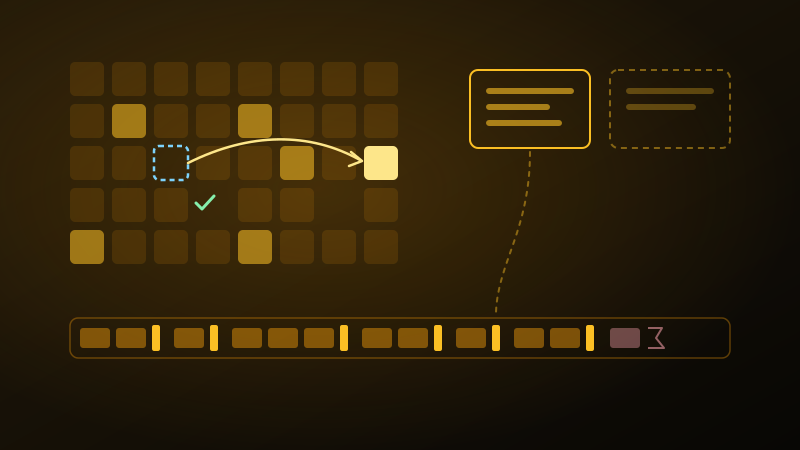
- Redirect-on-write. A write goes to a fresh physical block, and the block map is repointed only after the data and a small log record are durable. A torn write never damages live data, every block’s checksum stays valid, and snapshots share blocks with the live volume for free.
- Write-ahead log with group commit. One commit thread turns every waiting writer’s changes into one log group with one fsync. A group only counts on replay if its commit marker is intact, which makes multi-block batches atomic.
- Recovery that tells a torn tail from damage. Only the last group can be torn, so a bad record followed by a newer committed group is damage, and recovery refuses to paper over it. Two alternating checkpoint slots mean a crash mid-checkpoint costs a longer replay, not data. A failed fsync stops all writes rather than retrying.
- Fault injection. A simulated file system models what survives a power cut (unsynced writes dropped, kept, or torn sector by sector) and crashes the engine at every file-system call of a mixed workload. On top of that, every byte of the metadata and the log is flipped in turn, and real processes are killed mid-write. Every recovery is checked against a reference model and a full consistency check.
- Read path. A sharded CLOCK cache with admission control, an I/O thread pool that merges and parallelizes multi-block reads under O_DIRECT, and a block map split into 64 lock partitions, each measured on its own.
Result
- Recovery. 35 fault-injection scenarios, 8,875 checked cases, all passing: torn data and log writes at every crash point, every byte of the checkpoints and the log flipped in turn, real processes killed with SIGKILL mid-write, mid-checkpoint and mid-recovery, and failed fsyncs. No crash lost an acknowledged write, and every recovery passed a full consistency check.
- Bugs found by the suite. One flipped header byte could make recovery discard a whole log segment of committed writes; salvaging past damage could name blocks that later writes had reused. Both are fixed and both scenarios now pass.
- Read throughput (1 GiB volume, 8 threads, O_DIRECT): +25% on uniform random 4 KiB reads, 3.5x on 16-block batches, 8.6x on skewed reads. Each technique was measured alone too. Through the kernel’s page cache, skewed reads gained 73% but uniform reads lost 14%, since the kernel already holds the data; the benchmark write-up explains when each technique helps.
- Checked with ASan, UBSan and TSan in CI, on gcc and clang.